

This classic Scottish shortbread recipe comes from the handwritten recipe book of Mary Malcolm Palmer-Douglas in the National Library of Scotland’s collection.
Palmer-Douglas’s book collects recipes from a variety of sources, many of which she fastidiously recorded. This shortbread recipe is attributed to “Mrs. Ferguson 1894” (if I’m deciphering Palmer-Douglas’s cursive correctly). While Mrs. Ferguson may have been someone that Palmer-Douglas knew personally, it seems more likely that she was either a cookbook author or a cookery instructor. Most of Palmer-Douglas’s recipes came from cookbooks; several are copied directly from books such as Please M’m the Butcher (1922) by Beatrice Guarracino, Cookery and Housekeeping (1882) by Mrs. Henry Reeve, and The Economics of Modern Cookery (1900) by M.M. Mallock. Others are attributed to Beeton’s Cookery, Learning to Cook (1916) by Mrs. Peel, and Mrs. Black of the Glasgow School of Cookery (no specific cookbook is mentioned, but she wrote several). Several recipes also have notes such as “cake class” or “suet class,” indicating that Palmer-Douglas may have been attending cooking classes and acquiring recipes there.
The National Library of Scotland’s record dates this book to 1892, which is the date of the recipe on the first page. Many of the recipes are dated to the 1920s, however, or come from cookbooks that were published after the 1890s. A few are also dated much earlier, including a plum pudding dated to 1835. It’s possible that Mary Malcolm Palmer-Douglas started this book in the 1890s and kept adding to it over time; however, since many of the dates are not in chronological order (a recipe dated to 1928 appears as early as page 6), I think it’s more likely that she kept the book primarily in the 1920s and that the older dates are the dates of the original recipes’ sources, not the year she wrote them down. It’s difficult to know just from looking at the book online; I would love to visit the National Library of Scotland to see the book in person and find out more about Mary Malcolm Palmer-Douglas from the rest of her family’s collection. Perhaps with more research I could even discover who the Mrs. Ferguson of this recipe might have been.
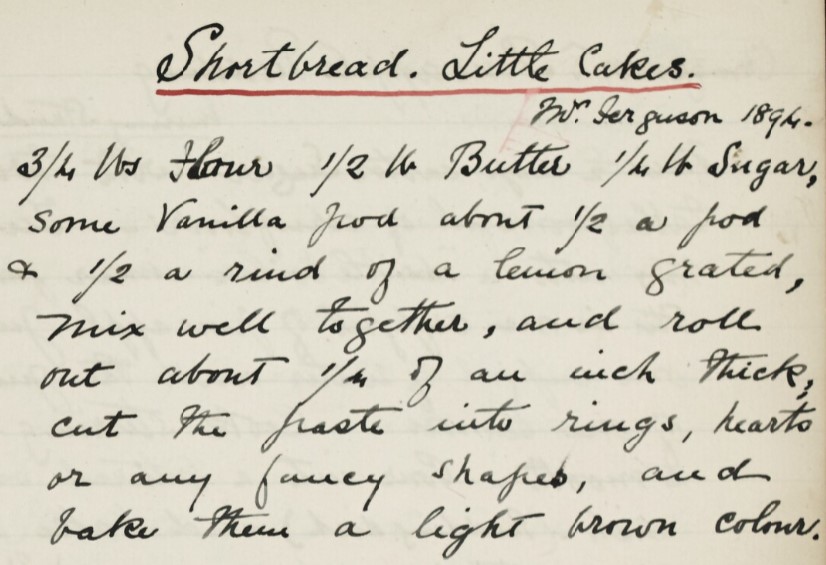
Shortbread little cakes:
- 3/4 lbs flour
- 1/2 lb butter
- 1/4 lb sugar
- 1/2 of a vanilla bean
- rind of 1/2 a lemon, grated
- Cream butter and sugar together.
- Add the lemon rind and scrape in the insides of half of a vanilla bean.
- Gradually add in the flour, mixing until a dry, crumbly dough is formed.
- Turn out and knead gently just until the dough comes together enough to roll out.
- Roll the dough out about 1/4 of an inch thick and cut into shapes, rerolling the scraps. The original recipe suggests making the cookies heart or ring-shaped.
- Bake at 350 degrees for about 15-20 minutes, depending on the size and shape of the cookies. My ring-shaped cookies baked a little faster than my heart-shaped cookies. Take out the cookies when the underside is firm and the edges are starting to turn a light brown.

Tasting notes:
This is the perfect shortbread. In my opinion at least, it has exactly the right buttery, crumbly texture, and isn’t too sweet. I’ve been testing out a lot of modern shortbread recipes lately to try to recreate my ideal shortbread, and none of them have even come close to this (I’m almost a bit disappointed that this was so good, because there were so many other recipes I wanted to try). If these cookies had a flaw at all, it was that the vanilla flavor was very subtle; but this could be because I used an ancient vanilla bean that had been languishing in my pantry for years. Next time, I will either put in more than half a bean, or just use fresher vanilla. The lemon was relatively subtle too, which I liked because I didn’t want it to overpower the cookies, but if you want more lemon flavor you could always grate a whole lemon instead of only half.
Thanks to Mary Malcolm Palmer-Douglas and the mysterious Mrs. Ferguson, I can now save all the money I used to spend on Walker’s Shortbread every year…and spend it on fresh vanilla beans for this recipe instead.
References:
Palmer-Douglas, M.M. (c. 1892-1920s). Mary Malcolm Palmer-Douglas’ recipe book. Malcolm of Burnfoot papers (Acc.10708/7), National Library of Scotland. https://digital.nls.uk/102826552
 History in the Making
They look really tasty. Simple but timeless.
LikeLike