
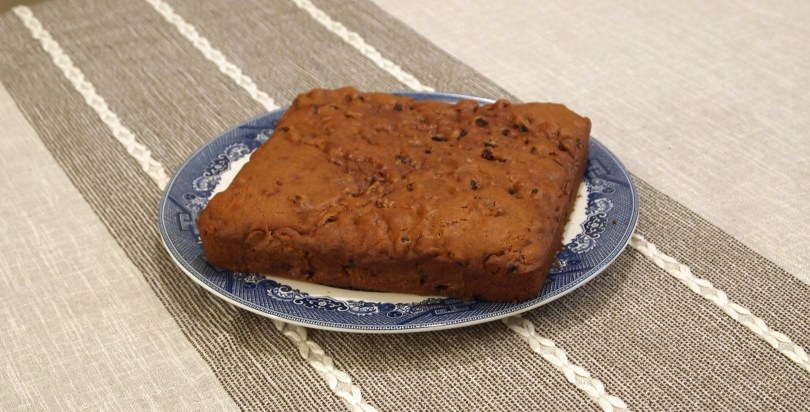
This recipe is one of many variations on “Eggless Butterless Milkless Cake,” an unusual recipe that became a staple during the food shortages of both World War One and World War Two. I’ve found similar recipes across dozens of cookbooks from the 1910s to the 1940s. Interestingly, while wartime cookbooks usually referred to this type of cake with names like “Eggless Butterless Milkless Cake” or “War Cake,” cookbooks published during the Great Depression often call it names such as “Depression Cake,” “Economy Cake,” or “Poor Man’s Cake.”
The differing names give an indication as to why this cake remained popular for so many decades; the cake could still be made even when fresh ingredients such as eggs, butter, and milk were difficult to come by, whether the shortages were caused by war or economic depression. Some wartime recipes even provided substitutes for the sugar and wheat in the cake as well. Others encouraged cooks to save their leftover fats, such as bacon grease, for use in the cake so that nothing went to waste.
I’ve searched in vain to try to find the “original” recipe for this cake. Two of the earliest references I’ve found to it are both from 1915, one from the yearly report of the Women’s Institutes of the Province of Ontario, and one from a bulletin of the Canadian Red Cross Society. Both describe selling the War Cake recipe as a fundraiser to benefit the Red Cross. Although the Red Cross may not have invented the recipe, their fundraiser certainly helped War Cake become so widespread. The recipe soon started appearing everywhere – in professional cookbooks, community cookbooks, and even magazine ads. Crisco published a War Cake recipe in ads throughout WWI, positioning their product as a perfect substitute for animal fats.

I also found a hilarious (and definitely fictional) origin story for Depression Cake in a 1941 essay written by Alice Prescott Young for the America Eats project. She attributes the recipe to a woman named Ethel, who wants to bake a cake for a Fourth of July celebration but realizes she doesn’t have any eggs, butter, or milk. In a moment of inspiration, she adds bacon drippings, spices, and flour to the pot of raisins bubbling on the stove, producing a “volcanic mass in her mixing bowl”:
…After a moment of hesitation, she put in a teaspoonful of flavoring. What was it? A cake or a pudding? She did not know…closing her eyes, [she] prayed fervently as she closed the oven door on the mystery.
…When the men came in weary and hungry from work, they were greeted at the door with the odor of that cake, which held the place of honor in the center of the table.
“How?” asked the man of the house, well aware of the lack of provisions.
“Eat it first.” answered Ethel. “I’m afraid to talk.”
Luckily, Ethel’s mystery “brain child” is a success and the Fourth of July celebration is saved (you can read the entire essay here, including Ethel’s “recipe”). Although Alice Prescott Young’s account of Depression Cake/War Cake is meant to be more entertaining than factual, it does accurately capture the ingenuity of bakers who struggled to make appetizing foods out of inadequate ingredients.
While there are many similar War Cake recipes out there, I chose to make one from the 1943 Betty Crocker cookbook Your Share, a wartime cookbook that claimed to help “the women of America” in their task to “make a little do where there was an abundance before.”
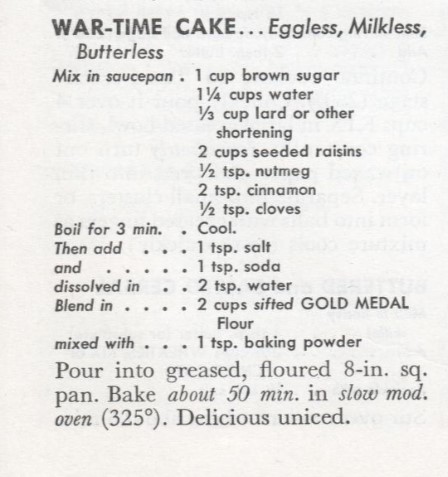
War-time cake:
- 1 cup brown sugar
- 1 1/4 cups water
- 1/3 cup lard or other shortening (this could be vegetable shortening, or leftover fats such as bacon drippings)
- 2 cups seeded raisins
- 1/2 tsp nutmeg
- 2 tsp cinnamon
- 1/2 tsp cloves
- 1 tsp salt
- 1 tsp soda
- 2 tsp water
- 2 cups flour
- 1 tsp baking powder
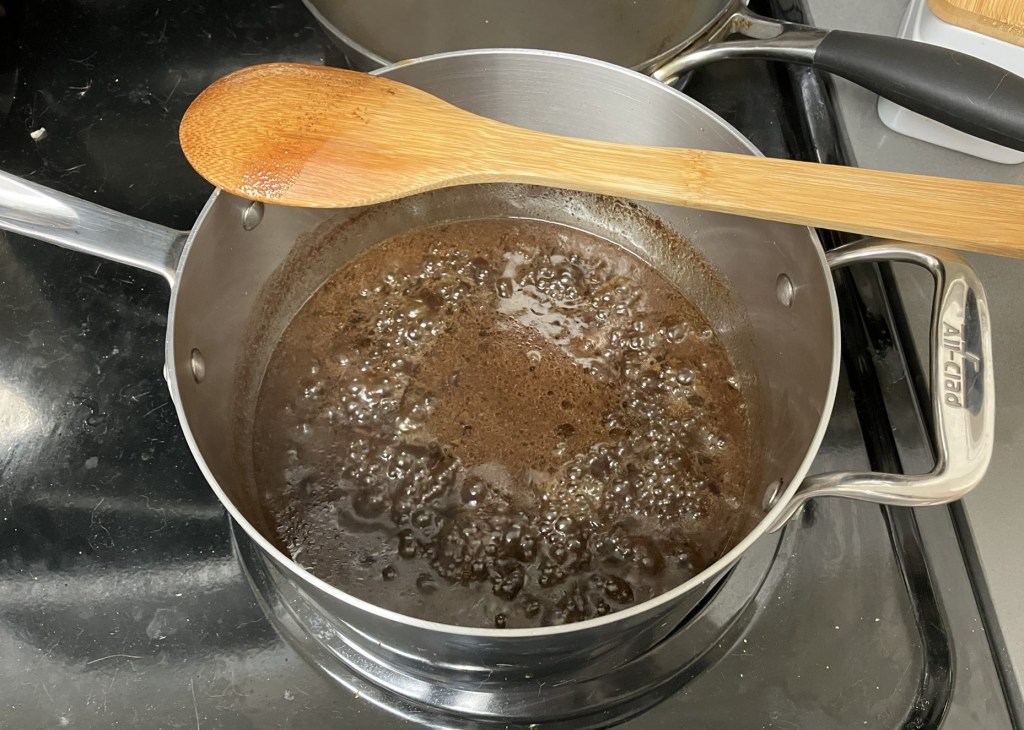
- Combine brown sugar, water, shortening, raisins, and spices in a saucepan (the rest of the ingredients will be added to the saucepan later, so choose one large enough to hold everything). Bring to a boil, then let boil for 3 minutes.
- Remove the saucepan from the heat and let it cool for a few minutes.
- Dissolve the salt and baking soda in 2 tsp of water, then add to the saucepan (this is the point at which it will look like a “volcanic mass”).
- Sift the flour and baking powder together, then stir into the saucepan.
- Pour the mixture into a greased and lined 8 inch square pan, then bake at 325 degrees for about 50 minutes.
Tasting notes:
I made this cake twice, once using leftover bacon grease and once using Crisco. The bacon grease cake definitely had a slight smokiness to it, so unless you are restricted by wartime rationing I would suggest using vegetable shortening or at least half shortening and half bacon grease. Even with the smokiness, this was a surprisingly tasty cake. It is a fruit cake, so it is fairly dense, but it keeps for a long time and was still moist after two weeks. The raisins were nice and plump due to being boiled with the other ingredients. It might not be the best-looking or best-tasting cake in the world, but if you’re ever out of eggs, butter, and milk, this is a good cake recipe to make in a pinch.

References:
Bulletin. (1915). Toronto: Canadian Red Cross Society. https://www.google.com/books/edition/Bulletin/PINA-tIBmXUC?hl=en&gbpv=0
Report of the women’s institutes of the province of Ontario. (1915). Toronto: Ontario Department of Agriculture. https://www.google.com/books/edition/Report_of_the_Women_s_Institutes/d_ZHAAAAYAAJ?hl=en&gbpv=0
Young, A.P. (November 5, 1941). Depression Cake. https://whatamericaate.org/full.record.php?kid=164-590-261&page=1
Your share : How to prepare appetizing, healthful meals…with foods available today. (1943). Minneapolis, Minnesota: General Mills, Inc. https://archive.org/details/YourShare/page/n27/mode/2up
 History in the Making
Great research! This cake sounds pretty good, and thank goodness for baking powder!
LikeLike
[…] War-time Cake […]
LikeLike
This cake (similar recipe) was in an old farmers cookbook when I was 9 years old. I asked my mom if I could bake a cake and she said if I could find a recipe with no eggs, butter or milk I could make it. This was the one I found and still make it to this day and I am 67. I’ve carried the cookbook everywhere with me throughout the years.
LikeLike
My copy of my recipe is getting hard to read. But i did like some of the directions. If doubling this recipe use enough lard to be about the size of a small egg. Fun to read old recipes
LikeLike
[…] How good these recipes are is another question, however. Most war cakes were overly crumbly or dense, not exactly a mimic of an airy yellow birthday cake. And other substitutions were slightly […]
LikeLike
[…] these recipes are is one other query, nevertheless. Most battle muffins have been overly crumbly or dense, not precisely a mimic of an ethereal yellow birthday cake. And different substitutions have been […]
LikeLike
[…] How good these recipes are is another question, however. Most war cakes were overly crumbly or dense, not exactly a mimic of an airy yellow birthday cake. And other substitutions were slightly […]
LikeLike
My grandmother made this cake when I was young. I remember eating it on carnival pink plates that my uncle (her oldest son of 8 children) would win pitching dimes at the fair. It was delicious and I’m so happy to find this recipe. I’m 83.
LikeLike