
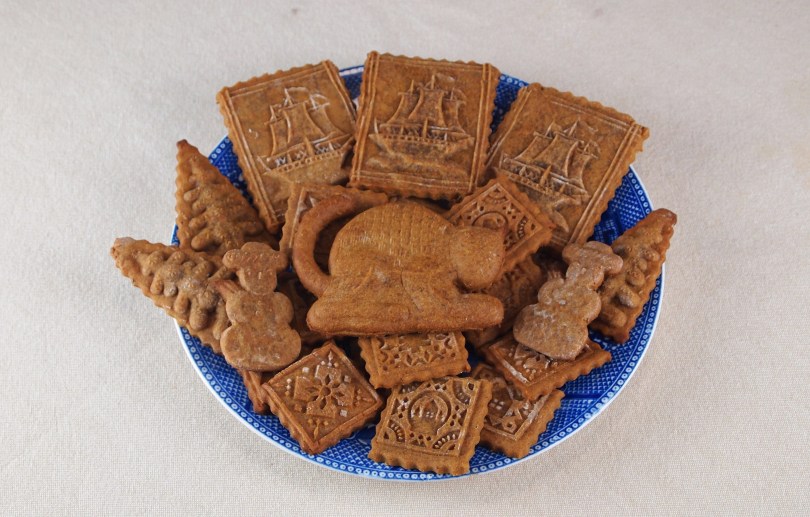
I’m always fascinated by recipes that pop up over and over again throughout different cookbooks. Early cookbook authors copied from one another extensively, frequently reprinting recipes from other cookbooks word-for-word or with only a few minor alterations. The copied recipes are almost never attributed to their original authors, a practice that would be considered plagiarism today but was common at the time. I’ve found this exact gingerbread recipe in three 18th and 19th century cookbooks so far, and wouldn’t be surprised if it turns up in more.
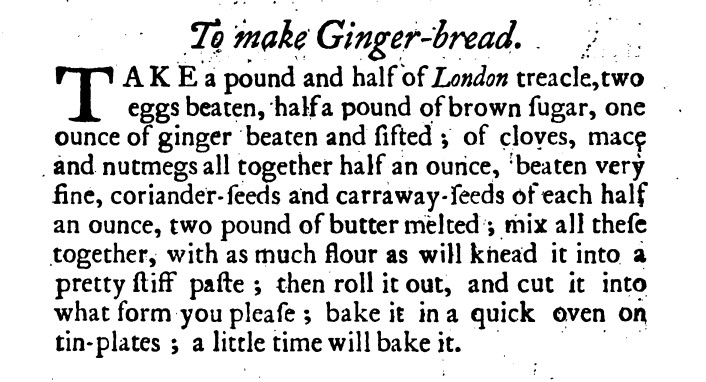
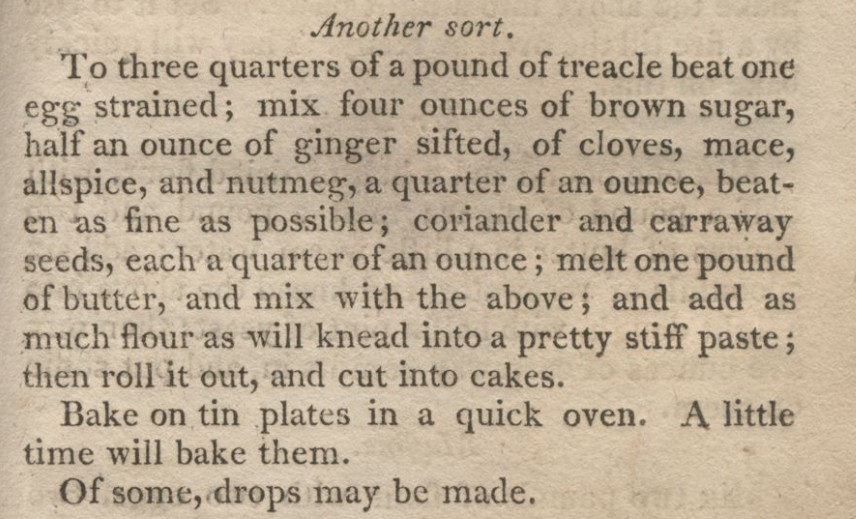
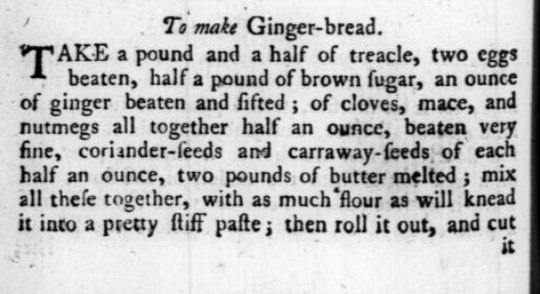
I first encountered and saved this recipe when looking through Eliza Smith’s 1739 cookbook, The Compleat Housewife. Then, while reading the modern cookbook How to Cook the Victorian Way With Mrs. Crocombe, I realized that they seemed to have almost the exact same recipe (although they adjusted some of the ingredient proportions) – but attributed it to Maria Rundell’s 1807 cookbook instead. Sure enough, Rundell’s recipe is nearly identical to Smith’s, although she halves the recipe and adds allspice to the list of spices. Finally, after I had already made the recipe, I saw that Tasting History with Max Miller’s YouTube channel had made a gingerbread from John Townshend’s 1773 cookbook that turned out to be word-for-word the same as Eliza Smith’s (the only difference is that he omits the word “London” before “treacle”).
I followed How to Cook the Victorian Way With Mrs. Crocombe‘s instructions to heat the treacle, sugar, and butter together, to chill the dough overnight, and to chill the molded cookies for at least an hour before baking. Although none of these steps are explicitly stated in any of the original recipes, it’s reasonable to think that the recipe authors might have assumed their readers would already know to do this and thus didn’t write it out. In Max Miller’s video, he didn’t chill the dough overnight and simply left the cookies out to dry at room temperature for a few hours instead of chilling them. That also seems to have worked, so there are certainly multiple ways to interpret this recipe.
Ginger-bread (1/4 of Eliza Smith’s original recipe):
- 6 oz treacle (molasses)
- 1/2 of an egg, beaten
- 2 oz brown sugar
- 1/4 oz ground ginger
- 1/8 oz total ground cloves, mace, and nutmeg (add allspice for 1807 version)
- 1/8 oz ground coriander seeds
- 1/8 oz ground caraway seeds
- 8 oz butter
- pinch of salt (optional, add if using unsalted butter)
- about 12-13 oz flour
- If you are using whole spices or seeds, measure them out first and put them in a spice grinder until they are finely ground.
- Put the treacle, sugar, and butter in a saucepan over low heat and warm through until the butter is melted.
- Add the ground spices and cook for 2 minutes more.
- Remove saucepan from heat and mix in the egg.
- Add the flour a little at a time and mix thoroughly to obtain a smooth, glossy paste. The original recipe does not give a measurement for flour, so I added flour a little at a time until it looked right. I tried to keep track of how much flour I was adding as I went, but it’s hard to be exact. The dough will firm up as it chills so it’s ok for it to still be fairly soft and sticky at this point. Wrap well in plastic wrap and chill overnight.
- If using molds for the cookies, flour the molds thoroughly before each use. Break off chunks of dough and press them firmly into the mold with your thumbs. If the mold is on the larger side, you can roll a rolling pin over the back of the mold to flatten out the dough. Carefully tap or peel the molded cookie out of the mold, trim off the edges, and place on a baking sheet.
- After molding the cookies, chill them for at least 1 hour before baking.
- Bake at 350 degrees for about 5-12 minutes – the time will vary a lot depending on the size and thickness of the cookies. The cookies should be baked until the bottoms are firm and the edges are just starting to turn brown. Most of my cookies were pretty small; if you’re using a larger mold, you might want to lower the oven temperature to 325 and bake the cookies a little longer.
- Let the cookies cool on the baking sheet for a few minutes before transferring them to a cooling rack.
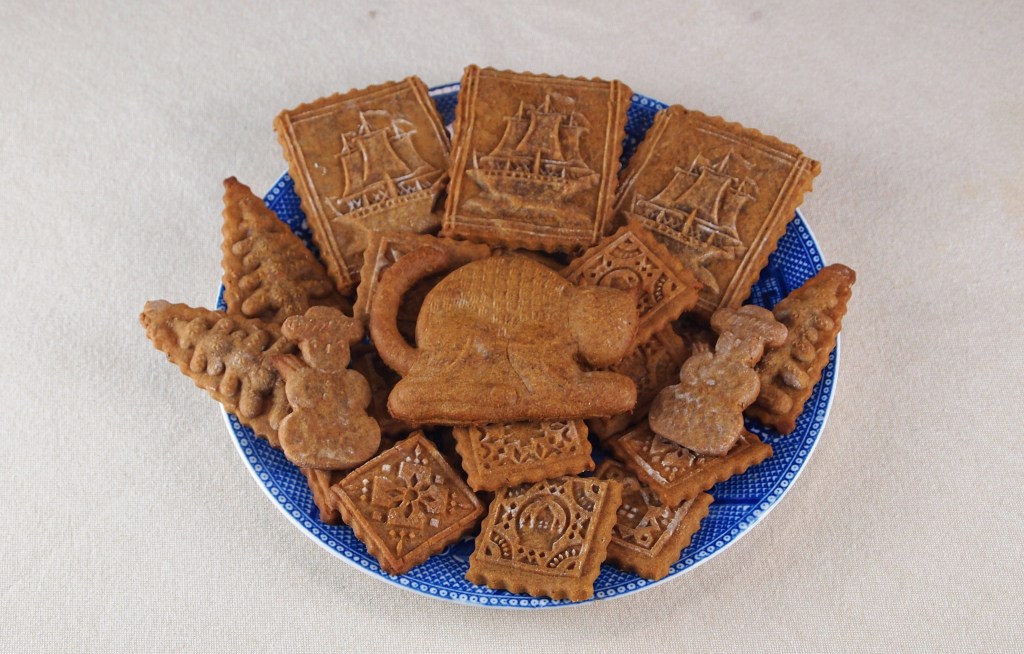
Tasting notes:
This gingerbread is delicious. While ginger, cloves, and nutmeg are pretty standard in modern gingerbread, the additional coriander and caraway seeds add a lovely depth to the flavor. I was a little worried about what the texture would be like without any baking powder or leavening, but the texture was perfect – chewy without being too solid, even for the thicker cookies.
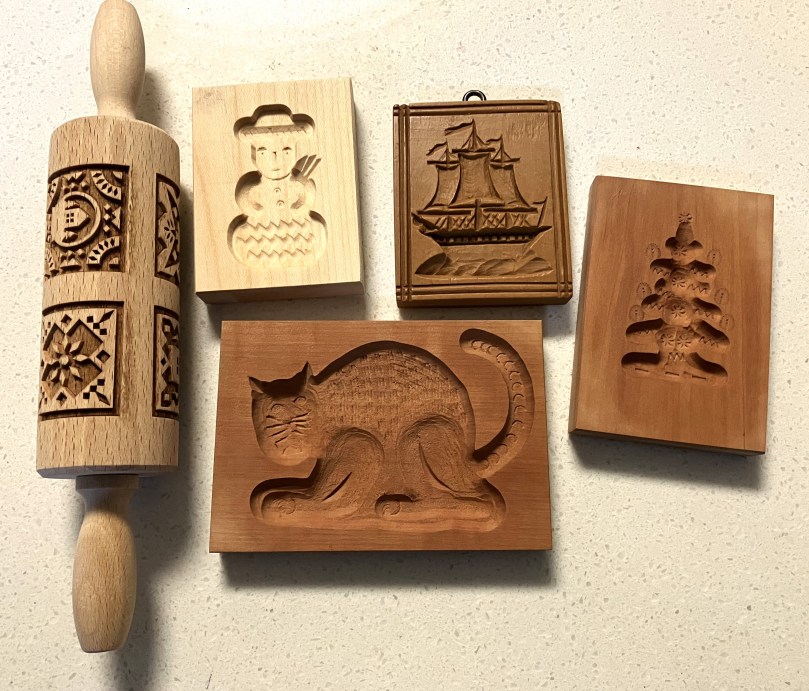
I used one resin cookie mold I already had and some wooden molds that my parents brought me from Christmas markets in Austria last year. While molding the cookies individually was definitely time-consuming, I think the final appearance of the cookies is absolutely worth it. They held their shape well in the oven and looked beautiful without any additional decoration. However, simply rolling out the dough and cutting it with regular cookie cutters would work with this recipe too.
References:
Gray, A., & Hann, A. (2020). How to cook the Victorian way with Mrs. Crocombe. London: English Heritage.
Rundell, M. (1807). A new system of domestic cookery: Formed upon principles of economy, and adapted to the use of private families. Philadelphia: Benjamin C. Buzby. https://n2t.net/ark:/85335/m5z60h504
Smith, E. (1739). The compleat housewife: Or, accomplish’d gentlewoman’s companion. London: J. and J. Pemberton. https://www.google.com/books/edition/The_Compleat_Housewife_Or_Accomplish_d_G/7OJQAQAAIAAJ?hl=en&gbpv=0
Tasting History with Max Miller. (2025, December 2). Gingerbread for Washington’s army [Video]. Youtube. https://youtu.be/vuoThloIEhs?si=3LGBmLi–f576xYp
Townshend, J. (1773). The universal cook: Or, lady’s complete assistant. London: S. Bladon. https://archive.org/details/bim_eighteenth-century_the-universal-cook-or-_townshend-john-master-_1773/page/n281/mode/2up
 History in the Making