
Published in 1932 in the midst of the Great Depression, Sheila Hibben’s The National Cookbook became a national sensation in America. In her introduction, Hibben wrote that she was inspired to write her cookbook after seeing a newspaper article featuring an elaborate recipe for a dog sculpted out of whipped cream paddling in a tureen of soup. She hoped that instead of making “frivolous novelties” and “elaborate atrocities” such as the whipped cream dog, her book would “call people home…to learn from the experience of our fathers the best and simplest way of eating.”
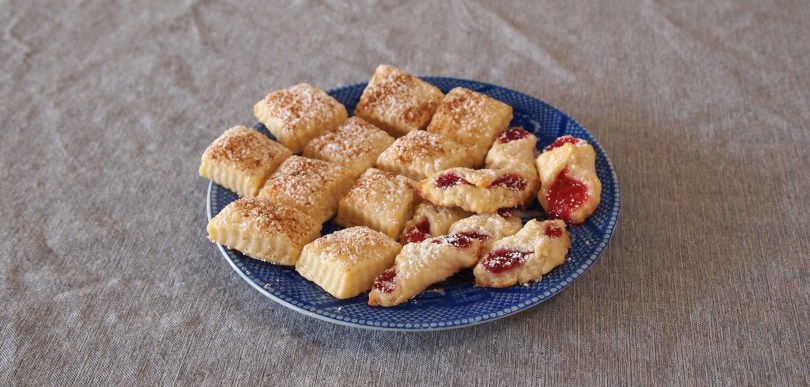
This recipe for cheese cookies is definitely pretty simple – it only calls for 5 ingredients (plus jelly if you make the filled version). Although Hibben doesn’t give a name for these other than “cheese cookies,” the filled versions sound very similar to kiffles or kołaczki, cream cheese cookies that are popular holiday cookies in Hungary, Poland, and other Eastern European countries.

Cheese cookies:
- 1/4 lb cream cheese, softened
- 1/4 lb butter, softened
- 1 cup flour
- cinnamon
- powdered sugar
- jam
- Using a stand mixer, cream together the butter and cream cheese.
- Sift in the flour and mix everything together thoroughly.
- Chill the dough for at least 3 hours, or overnight.
- Divide the dough in half and leave one part in the fridge while you roll out the other. Roll out the dough on surface dusted with flour or powdered sugar (or both) to about 1/8 of an inch thick.
- Use a knife or a fluted pastry cutter to cut the dough into 2-inch squares.
- You can either bake the squares as-is, or you can add fillings such as jams or jellies. For filled squares, put a very tiny dot of filling in the center of the square (about 1/8 tsp or less – it will look like it’s not enough, but if you add more, it will overflow everywhere). Bring two opposite corners of the square together and pinch to seal.
- Bake both the plain and filled cookies at 350 degrees for about 12-14 minutes, until the edges start to turn golden brown.
- Let cool for a few minutes, then sprinkle with powdered sugar while the cookies are still warm. For the plain cookies, dust them with cinnamon as well. The cookies will be very delicate when they first come out of the oven but should lift off the tray easily when cool.
Tasting notes:
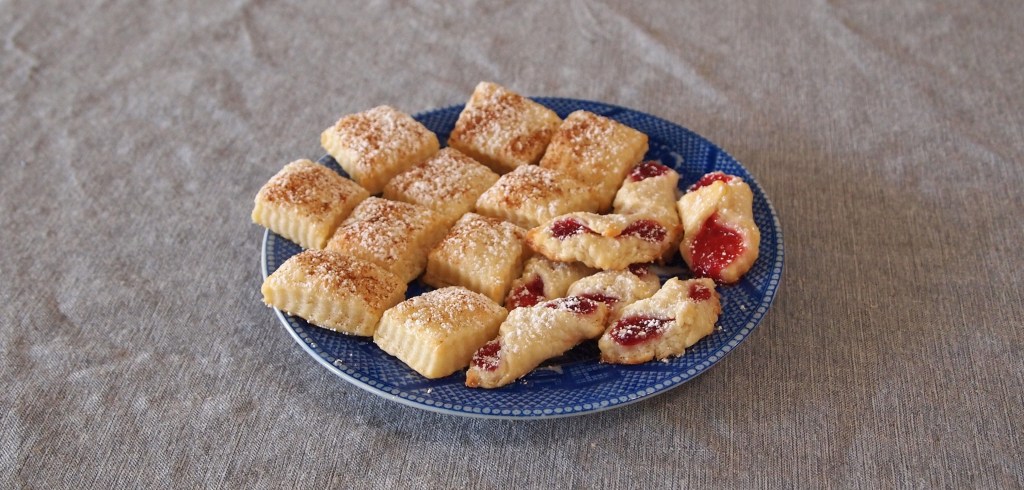
I had a lot of trouble with getting my filled cookies to stay sealed – in the photo below, only one out of a tray of 12 cookies stayed closed in the oven. The remaining 11 still tasted fine, but just didn’t look as pretty. Some of the modern recipes I looked at called for brushing the filled cookies with an egg wash, which might help the seal stick a little better. I found that it worked best when I used a teeny-tiny smidgeon of filling, pinched the corners very firmly together, and then rolled the sealed corners almost to the underside of the cookie. Still, despite doing this for my second batch, I still had a few failures that popped open in the oven.

While the jam cookies did taste good, I think I actually preferred the plain ones. The cookies rose up a lot in the oven and were just as light and flaky as a puff pastry, but were much, much easier to make. The plain cheese cookies would be excellent if you need to make a quantity of cookies and don’t have a lot of time. As long as you have the time for chilling the dough, the active time rolling out and cutting the cookies into squares doesn’t take very long. The cookies were still good after a few days too, but for maximum flakiness you should eat them while they’re still slightly warm from the oven.
References:
Hibben, S. (1932). The national cookbook. New York: Harper & Brothers Publishers. https://catalog.hathitrust.org/Record/009108006
Ziegelman, J., & Coe, A. (2016). A square meal: A culinary history of the Great Depression. New York: Harper Collins.
 History in the Making
They do look a lot like my friend Barb’s grandmother’s Hungarian Kolaches! A very tasty cookie.
LikeLike